Brothers of the Stream — Two clansmen share a moment of rest by the turquoise pool. After a long trek through the humid undergrowth, the cool mist of the waterfall provides welcome relief and a chance to wash away the mud of the journey.
Guardian of the Falls — A Sikerei stands sentinel at the base of the waterfall. In Mentawai culture, water is a purifying element, and these secluded falls are considered sacred places where the veil between the physical and spiritual worlds is thin.
The Meditative Gaze — Seated on a moss-covered boulder, a shaman rests in contemplation. The constant roar of the water drowns out the sounds of the jungle, offering a rare space for solitude and deep thought amidst the communal life of the tribe.
Lost in the Green — Two men framed by giant ferns and palms. The overwhelming saturation of green showcases the incredible biodiversity of the Siberut biosphere reserve, a world that remains largely untouched by modern development.
Spirits of the Undergrowth — Navigating the dense foliage requires instinct and experience. Here, the shamans pause to listen to the forest—perhaps hearing the call of a bird or the snap of a twig that signals movement nearby.
Emerging from the Green — A Mentawai hunter steps silently out of the dense undergrowth. His red loincloth (kabit) serves as a vibrant contrast to the endless sea of green, signaling his presence to the spirits of the forest while he navigates a path known only to his clan.
The Silent Stalk — With bows in hand, the hunters transition into stealth mode. The forest floor is littered with dry leaves, yet they move without a sound, their senses tuned to the slightest rustle that might betray the location of a monkey or wild boar.
Tension of the Bow — A study in concentration and form. The archer draws his bow, aiming nearly vertically into the towering trees. He must account for the wind, the leaves, and gravity, relying on instinct and a weapon design that has remained unchanged for centuries.
Staff of Authority — Standing tall with his staff, this Sikerei exudes authority. The staff is more than a tool; it is a symbol of his journey and his status as an elder who has walked these paths for decades to heal and protect his people.
The Long Trek — A shaman strides confidently through the undergrowth, aided by his walking staff. For the Mentawai, the jungle is not an obstacle but a pathway; they know every leaf, every root, and every turn of the ancient trails.
Scale of Nature — A wide environmental portrait showing the immense scale of the Siberut rainforest. The shaman appears as a humble figure against the towering cliff and cascading water, emphasizing humanity's small but vital place within the ecosystem.
Guardian of the Threshold — Standing at the entrance of the communal home, a figure is bathed in natural light. The Uma is not just a shelter; it is a spiritual fortress where the trophies of the hunt are kept and the ancestors are honored.
The Shaman’s Crouch — Inside the safety of the Uma (longhouse), a shaman rests in a traditional squat. This posture, comfortable for hours on end, keeps him ready to spring into action while allowing him to stay grounded near the hearth.
The Ritual Welcome — This quiet moment marks a significant spiritual milestone: the first visit of a shaman to a fellow healer's home. Before any news is shared or food is eaten, they sit together to initiate a welcome rite, acknowledging the sanctity of the occasion.
eins of History — As the ritual chant begins, the connection to the ancestors deepens. The traditional tattoos etched into their skin serve as a living map of their lineage, acting as spiritual conduits for the ancestors whose memory is now being honored.
Song of the Ancestors — Voices rise in unison, chanting a sacred melody passed down through time. This song is an offering to the spirits, a bridge built of sound that calls upon the ancestors to bless the bond between the host and his distinguished guest.
The Watcher at the Water — A closer look at the shaman by the falls. His red headband (luat) stands out against the dark, wet stone. He seems perfectly at peace, undisturbed by the spray of the crashing water behind him.
The Critical Move — The atmosphere inside the Uma turns quiet as the shamans engage in a serious round of dominoes. Brows furrowed in deep concentration, they calculate their next steps with the same focus they apply to hunting, treating the game as a genuine test of wit and strategy.
The Joy of the Game — The tension of the match suddenly shatters into laughter caused by a surprising move on the board. This moment of pure joy highlights the deep friendship between the men, showing that amidst the harshness of jungle survival, humor and playful rivalry remain essential for the soul.
Into the Twilight — Walking through the twilight of the deep forest. The lighting here is moody and atmospheric, capturing the feeling of the jungle as evening approaches and the nocturnal creatures begin to stir.
Camouflage — A hunter moves through the bush, his skin tones blending with the earth and wood. This image illustrates how the Mentawai live with nature, moving through the landscape as seamlessly as the jaguar or the gibbon.
The Strategy Session - Before stepping into the dense undergrowth, the trio pauses at the forest's edge. A senior shaman gestures with his arrow, mapping out the route and discussing the signs of the forest to ensure the group is aligned before the trek begins.
Consensus of the Elders - The conversation deepens as they debate the best path. In Mentawai culture, decisions are communal rather than commanded. Here, they share observations and reach an agreement, their voices low and blending with the sounds of the wilderness around them.
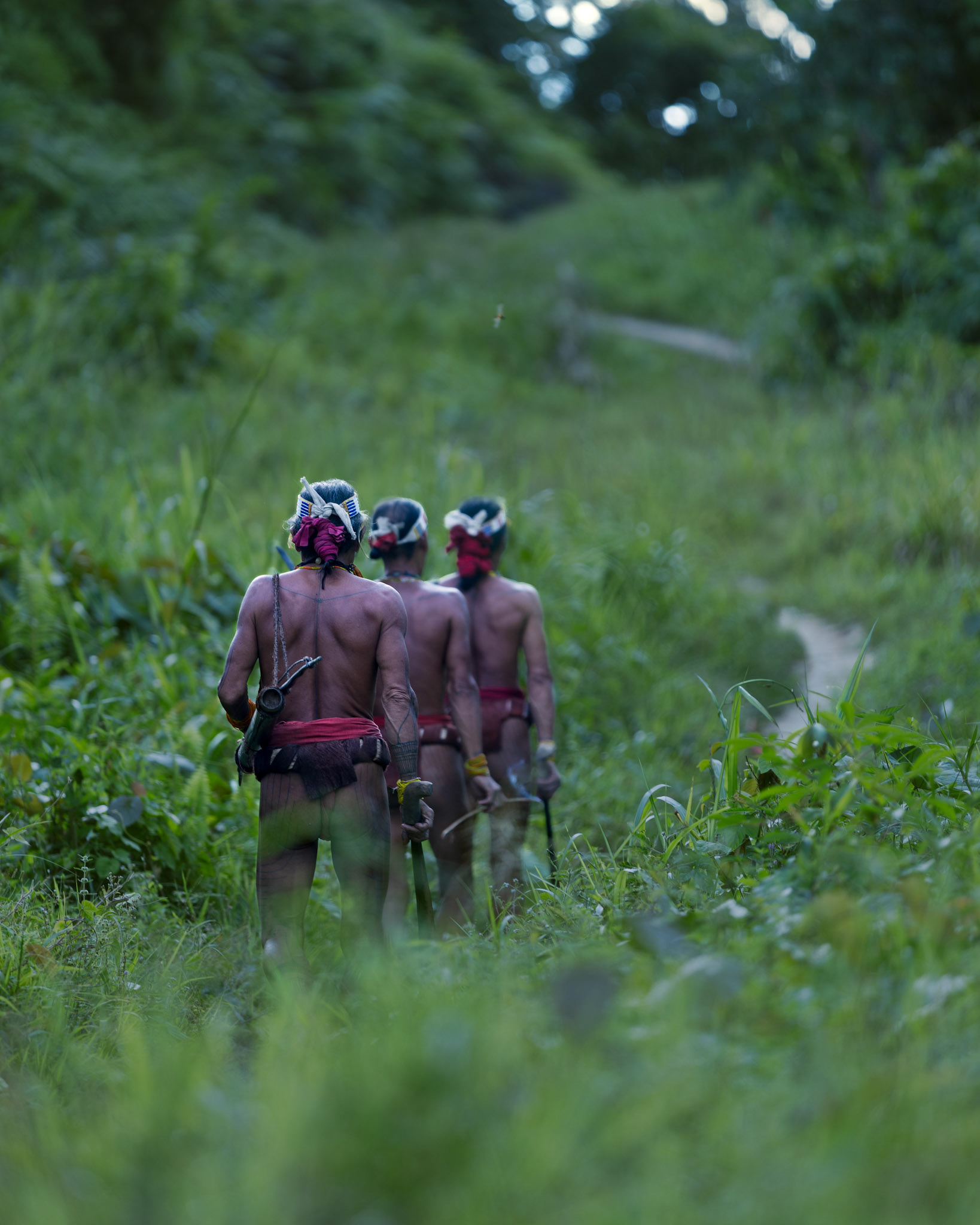
Into the Wild - Agreement reached, the group turns their backs to the village and steps off the cleared ground. Their red loincloths stand out against the verdant green, a vibrant signal of human presence as they enter nature's vast domain.
The Walking Council - Even in motion, the dialogue does not stop. They move at a rhythm that allows for both travel and teaching, pausing mid-stride to point out a disturbed branch or a medicinal plant, turning the simple act of walking into a mobile classroom.
Swallowed by the Green - As they venture deeper where the light fades, they fall into a single file. Their figures begin to merge with the forest shadows, symbolizing their role not as conquerors of this land, but as an integral part of its living, breathing ecosystem.
The Emerald Path — The final image captures the shamans engulfed by the forest. It is a visual metaphor for their existence: they are inextricably linked to this land, guardians of a green world that sustains them body and soul.
The Jungle's Vein — A majestic view of the waterfall cutting through the dense canopy. This fresh water is the lifeblood of the island, nourishing the sago palms and medicinal plants that the Mentawai people rely on for their survival.
Brothers of the Leaf — In the jungle, survival is a partnership. Two clansmen move in perfect sync through the thick ferns, their machetes at the ready to clear the way. They move not as intruders, but as part of the ecosystem, fluid and aware.